
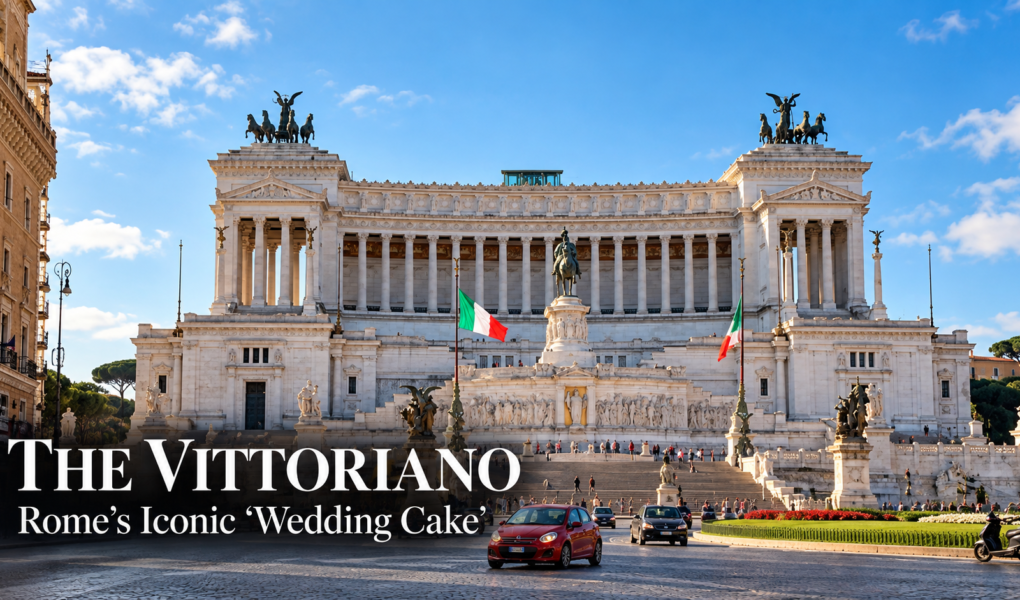
Travel • History • Rome’s Landmarks


In the heart of Rome, overlooking the bustling Piazza Venezia, stands one of the Italian capital’s most impressive and controversial landmarks. Gleaming white, with sweeping staircases, rows of columns, imposing sculptures and bronze chariots crowning its summit, it is impossible to miss.
Its official name is the Vittoriano, but many people know it by its humorous nicknames: the “Wedding Cake” and the “Typewriter.” To some, it is an architectural masterpiece; to others, an overly grand monument that seems out of place among the historic buildings of the Eternal City. Yet behind its unusual appearance lies the story of the birth of modern Italy.
Why Is the Vittoriano Called the “Wedding Cake”?

Stand in Piazza Venezia and look up, and it is easy to understand where the nickname comes from.
The monument consists of numerous horizontal levels, terraces and broad staircases rising one above another. Its white marble, symmetrical design and elaborate decorations create the impression of an enormous multi-tiered cake adorned with columns, statues and chariots.
Romans also have another popular nickname for the building: the “Typewriter.” Seen from certain angles, its complex composition and repeated architectural elements resemble an old-fashioned typewriter.
These names began as somewhat ironic descriptions. The building’s unusual shape and brilliant white stone stand in striking contrast to the warm ochre, yellow and terracotta shades of historic Rome. Over time, however, the nicknames became an inseparable part of the monument’s popular identity.
A Monument Dedicated to the First King of a United Italy

To understand the importance of the Vittoriano, we must return to the nineteenth century, when Italy was not yet the unified country we know today.
For centuries, the Italian peninsula had been divided into different kingdoms, duchies and territories, some under foreign influence. During the nineteenth century, the movement for national unification, known as the Risorgimento, gradually transformed the political landscape.
In 1861, the Kingdom of Italy was proclaimed, and Victor Emmanuel II became its first king. He went down in history as one of the key figures in the unification of the country.
Following his death in 1878, the Italian Parliament decided to build a national monument in his honour. The intention was not simply to commemorate the king, but to create a symbol of the new nation, its independence and its unity.
How Was This Giant Monument of White Stone Built?

In 1882, the design by the young architect Giuseppe Sacconi was selected. Inspired by the monumental architecture of antiquity, he envisioned a structure that would convey grandeur, dignity and national pride.
Construction began in 1885. The project underwent several changes, and the work continued for decades. The monument was officially inaugurated on 4 June 1911, when Italy celebrated the fiftieth anniversary of its unification. Finishing work continued for years afterwards, with the complex completed in 1935.
One of the most interesting details is the choice of building material. Rather than using the travertine found in many Roman buildings, the architects chose pale Botticino marble from Lombardy. Its almost luminous white colour is what makes the monument stand out so dramatically from the surrounding historic architecture.
However, the construction of the Vittoriano came at a cost. To make room for the monument, parts of medieval and Renaissance neighbourhoods on the slopes of Capitoline Hill were demolished. Some historic buildings were moved and reconstructed elsewhere.
The monument therefore became both a symbol of national unity and a controversial example of how modern ideas of grandeur can transform a historic urban landscape.
The Altar of the Fatherland and the Tomb of the Unknown Soldier

One of the most important parts of the complex is the Altar of the Fatherland (Altare della Patria). Although many people use this name to refer to the entire monument, it technically identifies a specific central section of the Vittoriano.
Here lies the Tomb of the Unknown Soldier, a memorial honouring the soldiers who died for Italy whose identities and burial places remain unknown.
The remains of the Unknown Soldier were laid to rest here on 4 November 1921. The eternal flame and ceremonial honour guard make this an active national memorial rather than simply a tourist attraction. During official ceremonies, wreaths are laid in remembrance of the fallen.
When visiting the monument, take a few moments to observe the memorial respectfully. Behind the impressive façade lies a place of profound significance to Italy’s national memory.
The Bronze Chariots That Seem to Soar Above Rome

Look towards the highest part of the building, and you will notice two enormous bronze chariots, each drawn by four horses. They are among the most recognisable features of the Vittoriano.
These sculptures, known as quadrigas, symbolise the Unity of the Fatherland and Freedom. They draw on imagery from the ancient world, where chariots were associated with victory, power and triumph.
The Vittoriano brings these ideas together through its classical architectural forms, the scale of ancient sanctuaries and the symbolism of the modern nation-state.
Despite its ancient appearance, the building is not a monument from ancient Rome. It is a creation of Italy in the late nineteenth and early twentieth centuries, designed to serve as a national symbol.
One of the Best Views of Rome Is from the Top

One of the best reasons to visit the Vittoriano is its panoramic terrace at the top.
Visitors can take panoramic lifts to the Terrace of the Quadrigas, where spectacular views stretch across Rome’s rooftops, domes and historic landmarks. From here, you can see the Roman Forum area, the Colosseum and many other sights throughout the ancient and modern city.
This is an excellent spot for photographs, but it is also a wonderful place to get your bearings. From above, it becomes easier to appreciate how ancient Rome, medieval churches, Renaissance palaces and the modern capital coexist side by side.
If you have enough time, do not settle for a photograph from the square alone. The journey to the terrace offers an entirely different perspective on the Eternal City.
What Can You See Near the Vittoriano?


The Vittoriano’s location is one of its greatest advantages. Situated in Piazza Venezia, it is an ideal starting point for a walking tour through Rome’s historic centre.
Nearby attractions include:
- Trajan’s Column — an extraordinary ancient monument decorated with a spiral relief depicting the military campaigns of Emperor Trajan.
- The Imperial Forums — the remains of monumental public squares built by Roman emperors.
- The Roman Forum — once the political, religious and social heart of ancient Rome.
- Capitoline Hill — one of the city’s most historically significant locations, featuring a beautiful square designed by Michelangelo.
These sites can all be combined into a single walking tour. The Vittoriano is particularly convenient for visitors who want to explore both the ancient ruins and the more recent history of Italy.
Practical Tips for Visiting
- Allow at least 45–90 minutes if you want to explore the monument at a relaxed pace and enjoy the panoramic views.
- Check official opening hours and access arrangements before your visit, especially if you plan to use the panoramic lifts.
- Wear comfortable shoes, as the staircases are extensive and the surrounding area is ideal for a longer walk.
- Combine your visit with Trajan’s Column and the Imperial Forums to experience two very different periods of Roman history in one outing.
- Take time to observe the Tomb of the Unknown Soldier and follow the rules for behaviour around the memorial.
For official information about the monument and visiting arrangements, see the VIVE website — Vittoriano and Palazzo Venezia.
The Vittoriano: More Than Just a “Wedding Cake”
At first glance, the Vittoriano may seem like an excessively grand white building trying to outshine everything around it. Perhaps that is precisely what makes it so memorable.
Yet behind its playful nicknames — the “Wedding Cake” and the “Typewriter” — lies a monument that tells the story of a united Italy, its national ideals and the memory of those who died in war.
It is not as ancient as the Colosseum, nor does it have the warm colours of Rome’s old palaces. Instead, it impresses through its sheer scale, white marble and commanding presence in the cityscape.
So, the next time you stand in Piazza Venezia, look beyond the nickname. The Vittoriano is far more than an unusual building for photographs. It is one of the most important symbols of modern Italy — a place where architecture, history and national memory meet in the heart of Rome.
9
9


